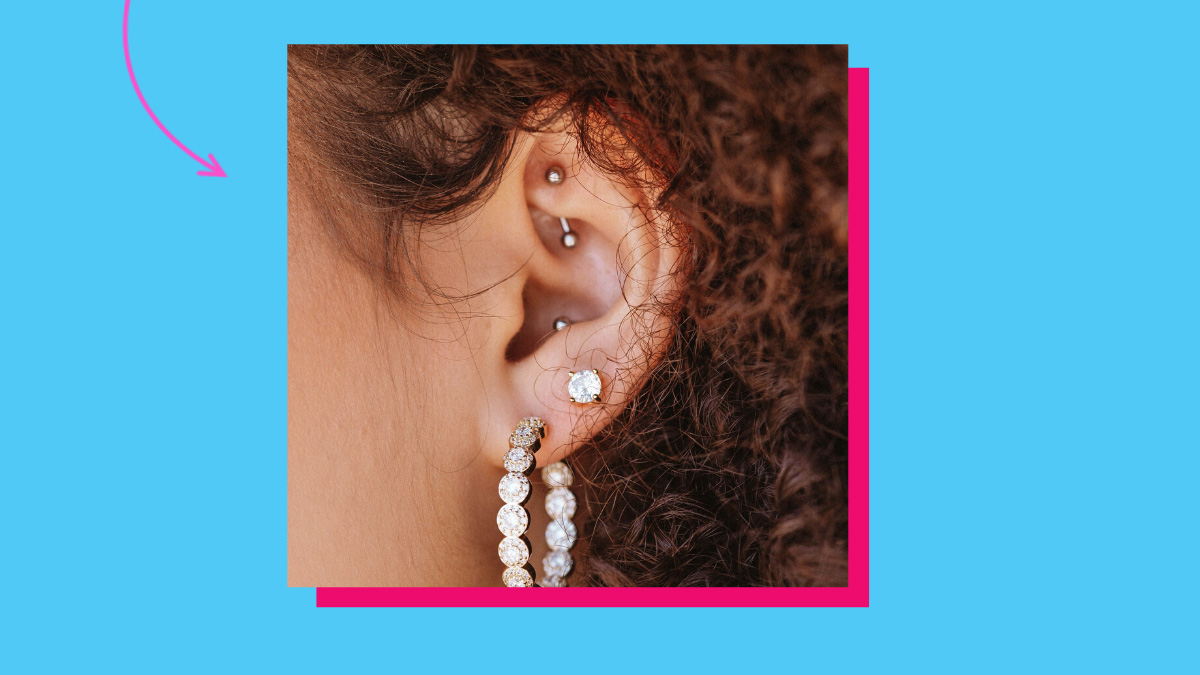
Thinking about getting a piercing but worried about the pain? You're not alone. Although the pain of getting a piercing can be off-putting for some, it needn't be something that prevents you from jazzing up your ears – or nipples. Whatever takes your fancy.
So, what's the tea on painful piercings? We spoke to Saoirse Flynn, head piercer at Metal Morphosis, to find out about the most painful piercings and whether there's anything you can actually do to make them less painful.
What are the most painful piercings?
Although how someone experiences pain varies from person to person, Saoirse explains that: "Broadly speaking, sensitive areas can be more painful to have pierced."
As for what those sensitive areas are, the piercer says that nostrils and intimate areas are often reported as being the most painful, by those getting the areas pierced, as well as parts of the ear that have thicker cartilage.
Why are some piercings more painful than others?
Reminding us that "pain can be a subjective thing," Saoirse says: "One person may find their conch piercing [in either the upper or lower concha part of the ear] to be very painful, while another may not find it painful at all."
"Everyone is different and every piercing is different," she emphasizes.
Explaining why piercings hurt altogether, the expert tells us: "Following a new piercing there will be a sudden increase in blood flow which can cause heat, pulsing and a feeling of pressure or a dull ache."
These feelings are to be expected with any piercing, so it's important to speak to your piercer who'll be able to "explain what kind of sensations" you're experiencing as well as "what you can do to try and kept your body as calm as possible."
"Try not to let fear stand in the way of you and the piercing you want. Piercing discomfort is short lived and thinking about the piercing process is often worse than actually getting pierced," she adds, emphasizing that: "Piercers are experienced with supporting clients through these worries and can talk you through everything so that you can feel safe throughout the process."
How to prepare for a painful piercing
"Firstly, keep in mind piercings do not take long to perform and are different to medical treatments where a person is unwell and their body is under a lot of stress," Saoirse tells us.
"Eat within the hour you plan to get your piercing and bring water and a small snack for afterwards," she adds, explaining that, "our bodies handle adrenaline differently and sometimes it can help to refuel afterwards."
Are there any ways to make getting a piercing less painful?
"Most piercers will not recommend using any numbing products, and are not permitted by licensing to apply any to a client," Saoirse says, referencing tips circulating on social media that suggest applying a numbing cream before getting a piercing.
However, that's not to say there isn't anything you can do to prepare for a piercing. "There are many things that can help your body stay as calm as possible and lessen anxiety and pain," she explains. "Many piercers will have you lay down flat for your piercing so that you can rest into the treatment bed and feel support rather than holding yourself sitting up."
Saoirse continues: "Breathing techniques are also incredibly useful while getting pierced. I personally ask my clients to take a deep inhale, then a long slow exhale while I pierce. This can keep everything calm and prevent a person having a shock that can cause very sudden adrenaline rushes or nausea."
How to look after a piercing
"Your new piercing will need to be looked after for the period of time advised by your piercer," Saoirse tells us. "Sterile saline is the best cleaning product to use on your new piercing, this can be purchased at your piercing studio, online or at a chemist." Notably, she says that contact lens solutions should never be used on a piercing "as they can have other ingredients like borax in them which can build up over the surface of your new piercing, blocking oxygen and trapping bacteria around it."
"Similarly, avoid making your own salt water solution at home," she adds. This is because "it can be very tricky to achieve the correct salt ratio which can lead to salt crystal build up on the piercing."
As for how often to clean your piercing – painful or not – Saoirse says: "Cleaning morning and evening is best to keep your piercing cleansed and to remove any build up that forms around the piercing. This can be done using a clean cotton bud or non-woven gauze, after the saline solution has been applied."
"Try not to play or fiddle with your new piercing," she adds, and "avoid swimming for the first four weeks." It's also advisable to "use a travel or ear pillow to reduce pressure on new ear piercings" when sleeping.
Finally, Saoirse recommends returning to the piercing studio "once the initial swelling has reduced" to have your jewellery changed. "It is best to reduce the size of the bar as the swelling drops down, this will help prevent piercing bumps forming or tears from long jewellery catching of hair and clothing."
Happy piercing!
This article is not intended to be a substitute for professional medical advice or diagnosis. Always seek the advice of your physician or other qualified health provider with any questions you may have regarding a medical condition.
***
This article originally appeared on Cosmopolitan.com. Minor edits have been made by the Cosmo.ph editors.