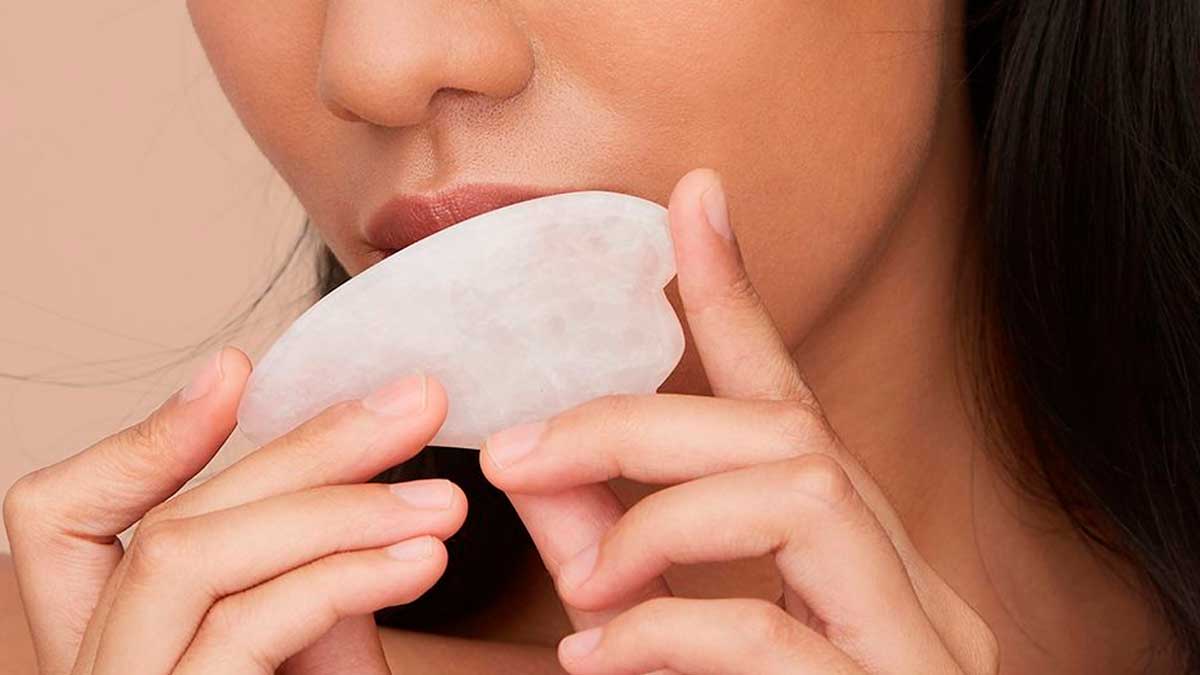
Here's a thing about me: I only like factual, science-backed skincare. Even if something is trending on my Instagram feed or in my group chat, I'm fully skeptical until I've got my dermatologist's input (sry, I don't like messing with my skin!). So when I started noticing gua sha—a skincare technique that's derived from traditional Chinese medicine—being offered at some of my favorite ~self-care~ spots I wasn't suuuuper confident that a stone (and a really pretty stone, at that) could make me look like a celebrity. That's why I immediately called up a derm and a gua sha expert to figure out everything there is to know—including, yes, whether or not the technique actually works.
What are the benefits of gua sha?
Welp, tbh, it depends on who you ask, and what school of thought (or, more accurately, training) they subscribe to. According to Sandra Lanshin Chiu, acupuncturist and founder of Treatment by Lanshin in Brooklyn, there are actually two types of gua sha—facial and body.
Body gua sha—a technique thought to stimulate the flow of blood, fluids, and energy within the body—is fairly aggressive (the pressure is heavy enough that it's not uncommon to be left with bruises post-treatment). But facial gua sha (a newer, more modern variation) is gentler, and instead involves "slowly stroking and massaging the face and neck to improve circulation and release tension, which can leave it less puffy and more glow-y."
But even though the results of gua sha are often immediately noticed (the zillions of post-gua sha selfies on Insta are proof), the effects haven't exactly been backed by science. "There's very little, if any, literature that proves the relationship between gua sha, increased blood flow, and lymphatic drainage," says Dhaval G. Bhanusali, MD, FAAD, a dermatologist at Hudson Dermatology and Laser Surgery. "I’m sure it can provide temporary improvement in appearance through basic massaging, but I’m not convinced the effects will last more than a few minutes." Womp, womp.
The good news? Dr. Bhanusali says gua sha is "relatively harmless," so there aren't any real concerns in getting—or giving yourself—a facial massage, as long as you aren't expecting to come out of it with a new face.
How often should you gua sha?
Down to try out gua sha for the first time? Consider booking an appointment with a specialist—since you're applying pressure onto your face, it's a smart idea to have a professional do it first so you have a sense of how it should (and shouldn't) feel. Once you're ready to take your practice to the comfort of your own bathroom, though, there are a few things Chiu suggests you keep in mind:
- Three is the magic number. "I recommend practicing facial gua sha at least three times a week in order to maintain the results of your at-home practice," she says. "Some people prefer to do it in the morning, others enjoy it before going to sleep, but for me, a quick facial gua sha is my favorite way to prep my skin for makeup."
- Using with products is key. "Start with a hydrating mist or alcohol-free toner followed by a facial oil or a moisturizer to prep your skin and get the necessary 'glide,'" says Chiu. "Skin that isn’t freshly hydrated may result in some 'sha,' or red marks—they're not permanent, but it’s not what you’re going for."
- Don't chill your tools. "In traditional Chinese medicine, we generally avoid using cold tools on the skin and body because cold constricts circulation," she says, suggesting you keep your gua sha tools at room temperature, not in the fridge or freezer.
If you're still feeling intimidated, YouTube tutorials are a great place to start. "It’s actually pretty simple and repetitive, so once you know the steps, it only takes eight to ten minutes," says Chiu. This video is a great introduction for first-timers:
What shape gua sha is the best?
"Stone quality, design, and craftsmanship matter when choosing a tool," says Lanshin. "As with any product you use on your face, do your research and don’t be afraid to ask questions." That means you'll want to choose your gua sha tool for function—even though that cutely shaped device might look pretty on your vanity, that doesn't mean it's the best one for your face and skincare concerns.
So should you gua sha or not?
At the end of the day, there are two types of people: Those who need a shit-ton of data and their dermatologist's stamp of approval before they do anyhing to their face (hi, it me), or those who don't really buy into Western medicine and are game to try out alternative treatments.
If you fall into the latter, there's no reason why you shouldn't take a stab at gua sha—especially since you're now equipped with every piece of knowledge you could need (yeah, yeah, you're welcome). And, TBH, I might just break my own rules and try it, too—at the very least, it'll be relaxing AF, right?
***
This article originally appeared on Cosmopolitan.com. Minor edits have been made by the Cosmo.ph editors.