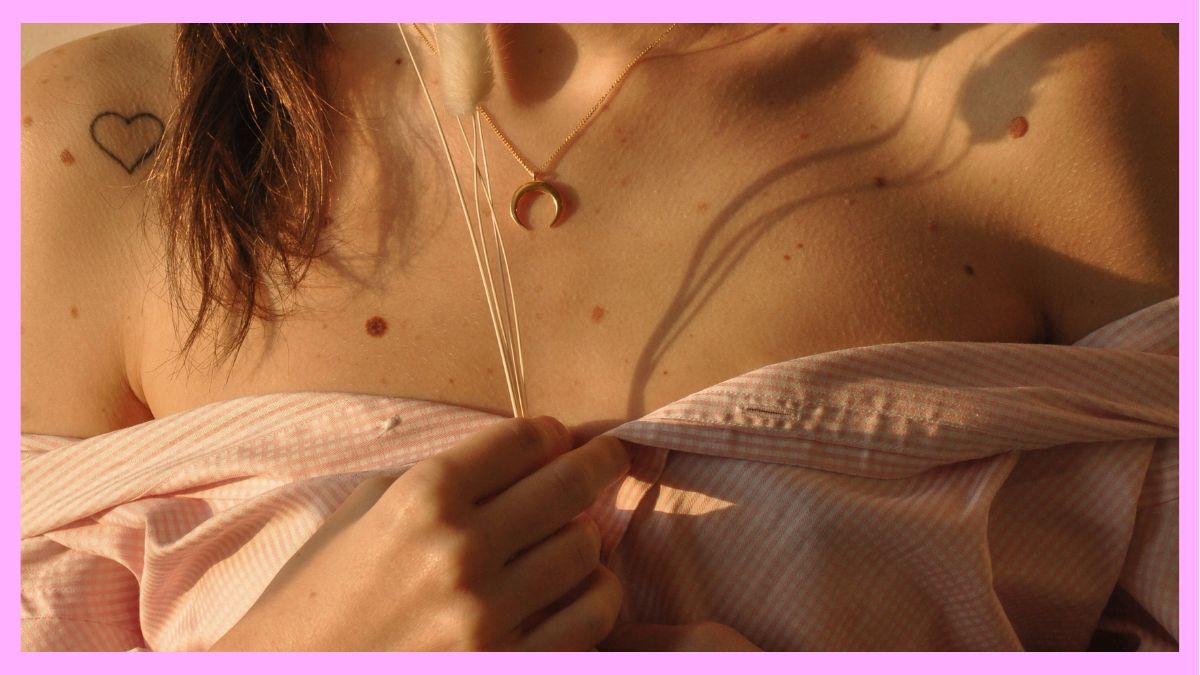
We're forever warned about looking after our skin in order to prevent skin cancer, and that includes paying special attention to our moles. But how do you know what to look out for? Is a raised mole always cancerous? Is a black mole okay? What mole changes do you need to keep a close eye on? While avoiding finding out the answers might be all too easy to do, cluing yourself up on the tell-tale signs that indicate one on your body may have the potential to become cancerous, can actually protect your health and help to offer reassurance.
So, to find out more about cancerous moles, including the key things to look out for, we spoke to Claire Crilly, skin cancer screening specialist at The MOLE Clinic...
How to check your moles
First things first. We should all self-monitor our moles every three months, Crilly says, and this can be done at home using what is known as the ‘ABCDE’ technique:
A - Asymmetry
Look for moles that are asymmetrical in shape, where one half of the mole is unlike the other.
B - Irregular border
Does the mole have an irregular border? Is it scalloped (unusual edges), jagged or poorly defined?
C - Irregular colour
Is the colour of the mole different from one area to another or does it have different shades of tan, brown or black?
D - Diameter
Check the diameter of the mole to see if it is bigger than 6mm (about the size of the end of a pencil).
E - Evolution
Is the mole evolving or changing size, shape or colour?
"Any new or changing moles should be seen by a skin cancer specialist," advises Crilly, who makes the helpful point that: "Moles are like a family, there should always be another mole that looks similar."
With that in mind, "if you have a mole on its own and looks as if it does not fit on your body, seek professional guidance from a skin cancer specialist."
What's more, Crilly notes that "some people are at higher risk of melanoma than others due to, for example, family history of melanoma, personal history, having over 100 moles, or atypical moles and should be monitored according to the above guidelines."
Cancerous moles
Moles come in all shapes and sizes, but some moles risk turning into skin cancer. These are the signs to look out for that a mole needs to be seen by an expert...
Your mole is... asymmetrical

Benign (non-cancerous) moles tend to be symmetrical. If you were to place an imaginary mirror in a line in the middle of the mole, it should be the same on either side. Remember, all moles are individual to the person, and no moles will be perfect. If a mole is asymmetrical, seek advice from a skin cancer specialist.
Your mole is... raised above the skin

There are many reasons why raised moles occur, the main one being a healthy benign intradermal mole (typically dome-shamed), which can be genetic, long standing, soft and sometimes wobbly to touch. They may lose colour or get darker with age. These types of moles should be monitored for drastic change, but generally aren't cause for concern.
However, moles that change and become raised could be an indication of melanoma (as pictured above), and as mentioned previously, if a mole changes, seek advice from a skin cancer specialist.
Your mole is... big

Some moles may be big due to the type of mole they are, for example a congenital mole (also known as a birthmark) which are present from birth and do not tend to change. However, due to their size and dark pigment they are at higher risk for melanoma, so keep an eye out for any changes or for any of the symptoms listed in the 'ABCDE' guide above.
Your mole has... many colours

If your mole has multiple colours you should seek advice from a skin cancer specialist.
Your mole is... black/very dark in colour

Depending on your skin type, your moles may well be darker in colour and by checking each of your moles regularly, you'll know what is normal for you. However, if your mole is dark in colour and different to others, or if it has changed in colour to become dark, do seek advice from a skin specialist. The mole pictured above is an example of a melanoma mole.
Some people may also develop a lentigo – also known as an ink spot – which is an extremely black but benign mole. Nevertheless, it is always safe to have these lesions assessed due to the dark pigment.
Your mole is... growing in size or changing shape

Moles can change over your lifetime, and can become darker, lighter, larger, fade or disappear completely. However, this should never be drastic or in a short space of time. If this does happen do seek advice from a specialist.
Your mole has... an uneven border

If your mole has an uneven border this can be a sign of change, and again this needs to be assessed by a professional.
Your mole is... itchy or sore
Large intradermal moles may catch on items of clothing which can cause them to be itchy or sore. However, if you have an itchy or sore mole you must seek advice from a skin cancer specialist.
Separately, if you have a hair growing out of your mole (which is common, our bodies are covered in hair!), this is usually a harmless sign. But as ever, if you're worried about it or it looks different to usual (or anything else you've noticed), still check it with a professional!
*This story originally appeared on Cosmopolitan.com. Minor edits have been made by Cosmo.ph editors.