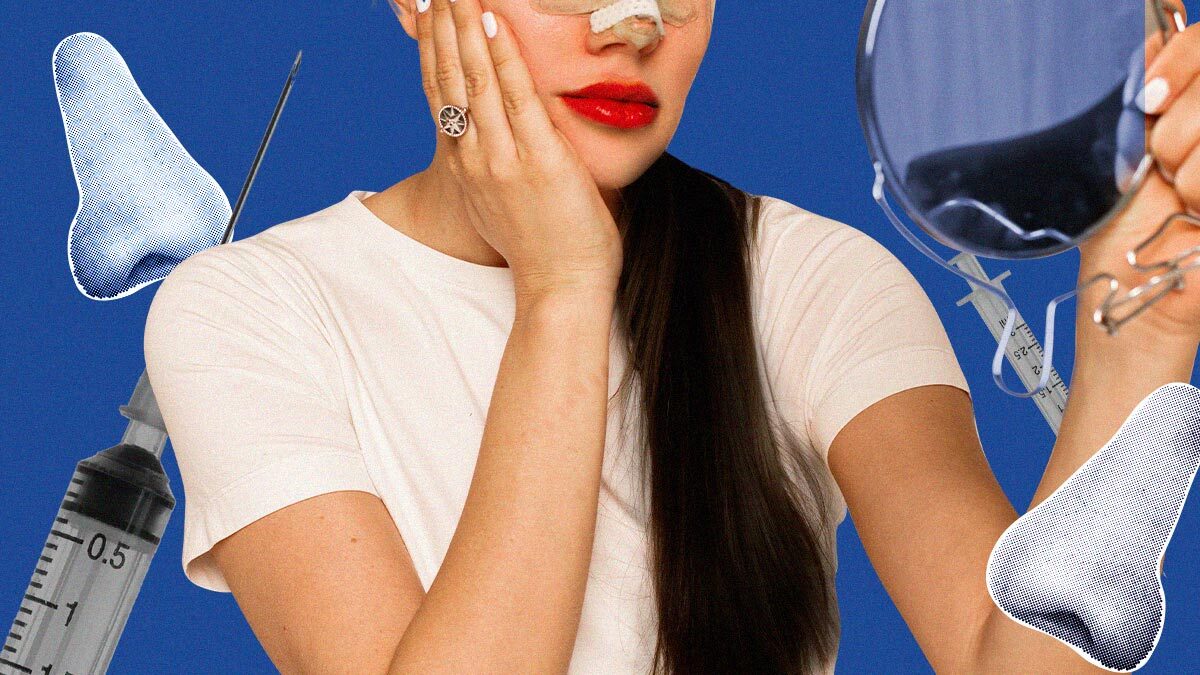
So you think you’ve saved up enough money and courage to finally get that nose you’ve always wanted? Here’s a reality check: It’s not as simple as what you see online. This special report gives the lowdown on the rising cases of botched nose jobs in the Philippines. Read on to find out what is at stake when you decide to take that nose dive into rhinoplasty.
All she ever wanted was a “glow-up.” Nothing too drastic, just a subtle improvement.
But three months and two surgeries later, Liz* found herself recovering from debilitating depression and extreme pain. She was also P400,000 poorer.
Liz's case may sound extreme, yet it is becoming all too common. With more and more celebrities and influencers flaunting their brand-new noses, people tend to get the impression that getting a nose job is as simple as going to the salon.
But too often, women are not aware that it’s a surgery that entails real physical risks. A nose job also carries mental, emotional, and financial risks—perhaps even more so than other types of surgeries.
Indeed, a nose job—or rhinoplasty as it is technically called—has become so accessible nowadays that it has sparked fierce competition among clinics and doctors. They’re all competing for a steadily growing market dominated by young women professionals like Liz.
But the rising aspiration for such a “glow-up” is also giving rise to the less-known practice of revision rhinoplasty, that is, an additional surgery to correct a previous faulty rhinoplasty.
The most common cosmetic procedure
Just a quick look at some Facebook groups dedicated to rhinoplasty will attest to the popularity of this most common cosmetic procedure in the country today.
For instance, “The ORIGINAL RHINOPLASTY SUPPORT GROUP PHILIPPINES (OFFICIAL),” one of the first Facebook groups in the country dedicated to rhinoplasty, has more than 107,000 members as of writing. More than three in every four group members are 25 to 34 years old, Quen Coldwater*, a group administrator, told Cosmopolitan Philippines.
READ: This Pinay Gets Real About What It's Like To Get A Nose Job
Why Risk It?
Everyone wants to look good. According to Llewelyn Issa Dela Cruz, a consultant psychologist at the Philippine Mental Health Association, every person has “some degree of aesthetic need or desire for beauty.”
Those who place a lot of value on this need are motivated to change their appearance. People are also moved by their “desire to feel happy, feel good, and to reward themselves,” Dela Cruz said.
“It also gives people a sense of empowerment,” she added.
Indeed, Liz considered getting a nose job as a form of self-care—a reward for herself after several years of putting her husband and three kids first. She did not find her nose ugly, but she thought it could be improved. “Kasi tumatanda na rin ako,” Liz, who was in her late 30s, said.
Liz chose her first surgeon after carefully reading up online on feedback about different doctors. “I did my research. I went for a surgeon with many rave reviews online and has a signature style,” Liz said.
Based on online testimonials of previous patients, she decided to go for a certain doctor although his professional fee was 30 percent higher compared to other doctors she inquired about. She was prepared to take the plunge but ignored the warning signs.
READ: Yikes! 3 Pinays Who Got Nose Jobs Are Now Demanding Refunds + Accountability From Their Surgeon
Red Flags Before Trusting A Doctor to Do Rhinoplasty
Looking back, however, Liz admitted that there were a lot of red flags. For one, she had never met or even talked to the doctor online before the day of surgery.
All her pre-operation consultations were done online with the doctor’s assistant, a nurse. She was the one who told Liz that she needed a Gore-tex implant—a synthetic material that was considered safer than the silicone material traditionally used for nose implants. She also discussed the payment requirement of a substantial deposit for her to secure a slot. The deposit, by the way, was non-refundable and non-transferable. Liz had to sign a contract attesting to this.
So even when Liz was beginning to have doubts about the surgery because she was concerned about what her family and friends would think, she could not ask for more time to think about it. The contract made it impossible for her to delay the procedure or swap schedules with another patient. The day of Liz’s rhinoplasty was cast in stone three months after she paid the deposit.
Liz met her doctor for the first time right before her surgery—after waiting for four hours because he came in late for their appointment. Liz overfasted in the process.
In her first face-to-face consultation with the doctor just minutes before the surgery, Liz made it very clear to him that she did not want a high bridge. She only wanted a “very subtle” improvement where people would not be able to notice any drastic change. “Parang nag-glow up lang,” she said.
A good four hours later when her sedative wore off, Liz woke up to seeing her nose already in a cast. “They did not show me the outcome,” she said.
“I looked like a witch”
A week later, when her sutures and cast were removed, Liz saw her new nose in the mirror for the first time.
“I looked like a witch,” she recalled thinking upon seeing that her bridge was so high. She almost did not recognize herself.
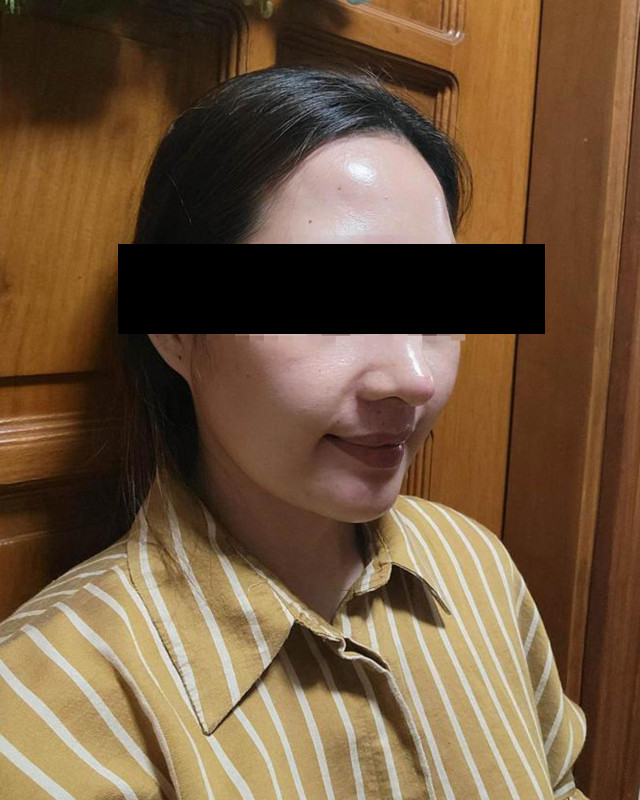
“For the first time in my life, I felt ugly,” Liz added.
After waiting for a couple of months for her rhinoplasty, the time has finally come for the unveiling of Liz’s new nose. But her high hopes quickly turned to dismay. She saw that her new nose was too high—the opposite of the subtle improvement that she wanted.
Liz voiced her concern to her doctor. His reply made her feel even worse.
“Kung ayaw mo palang magmukhang ganyan, bakit ka pa nagpagawa?” Liz recalled her doctor saying. “Tingnan mo nga yung itsura mo before, ang haggard-haggard mo. Compare mo naman sa itsura mo ngayon,” the doctor added.
Liz felt completely humiliated. She was utterly lost for words.
Into a spiral
Liz went home barely able to look herself in the mirror because of how much she hated her appearance. She could hardly recognize herself.
“Hindi ko maintindihan ang itsura ko,” she said.
She was also in severe pain because the tip of her nose was inflamed. This, she later learned, was because her skin was pulled severely taut—nearly to the point of rupture—by the height of the implant that was put in her by the doctor.
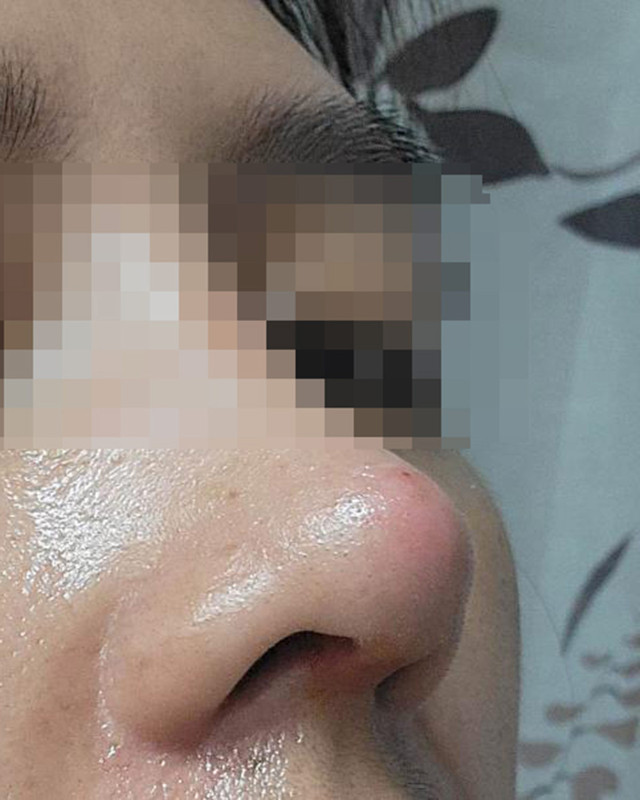
“Nagbayad ako ng mahal para pumangit at para mag-endure nang masakit,” she said.
She felt embarrassed but thought she had no one to blame but herself.
Liz went into a spiral. “I did not leave our bedroom for more than a month. I did not want to show my face to anyone except my husband. I stopped taking care of the kids. I stopped working,” she recalled. “I cried day and night. I could not sleep. I lost interest in everything. I couldn't even force myself to take a shower,” she added.
"Nagbayad ako ng mahal para pumangit at para mag-endure nang masakit."
Liz’s reaction, unfortunately, is not uncommon. According to psychologist Llewelyn Issa de la Cruz of the Philippine Mental Health Association, studies indicate that for people who already have depression, anxiety, and adjustment problems, a change in appearance can be “a trigger factor for distress, other psychosocial concerns or a relapse in their symptoms, particularly when they get dissatisfied with the results.”
“I was beginning to wonder how my kids would do when I’m gone. I was thinking, they would be okay. Andiyan naman ang asawa ko,” Liz recounted. These thoughts alarmed her so much that she willed herself to crawl back out of the depths of her depression.
Fighting misinformation
It was then that she discovered Facebook groups and learned about others who went through the same ordeal. She learned from group members about popular doctors like hers who might have the credentials but perform surgeries like an assembly line.
Certain doctors allegedly line up several surgeries a day, and you wouldn't be aware if the doctor you signed up for was the one doing your nose job. The running joke among group members was that even the clinic security guard would be called upon to scrub in just to finish all the procedures lined up for the day.
And then some doctors supposedly ghost their patients after the surgery—providing no post-operation aftercare.
Joining such groups made Liz realize that what she read before her surgery did not necessarily give the complete picture. She realized that testimonials about bad experiences could get filtered.
“Walang lumalabas na bad comments about sa doctor ko. Ako lang ang openly nag-post about my experience, na-decline pa ng admin ng group,” Liz recounted.
She found out later that the group administrator was friends with her doctor.
Quen Coldwater (not his real name), an administrator of the oldest Facebook Page in the Philippines dedicated to rhinoplasty, agreed that people need to be critical when they read testimonials and reviews.
“Social Media has been used by unscrupulous surgeons and clinics to promote their own products and services,” Coldwater, a professional banker who administers the group in his free time, said.
This is the reason the group has a rule against promoting a surgeon who has not “done” a member. “We want to fight misinformation,” Coldwater said.
It was in one such group that Liz found support. “I found out that if you post openly in such groups about a surgeon that you are considering, there will always be one person who will tell you about his own experience with that doctor, good or bad,” she said.
Liz also learned about surgeons who specialize in revision rhinoplasty. She finally found hope.
READ: How Much Does It Cost To Get A Nose Job In South Korea?
When revision rhinoplasty becomes a necessity
Dr. Richard Enrique, an Otorhinolaryngologist (ENT surgeon) whose sub-specialty is facial plastic and reconstructive surgery including rhinoplasty, says that one in every two of the rhinoplasty procedures he does is a correction of a prior surgery done by another doctor.
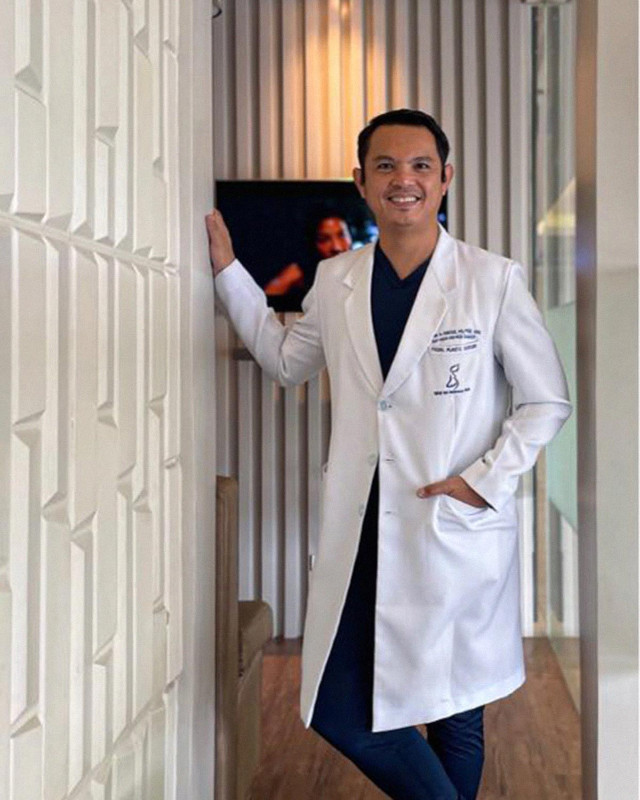
That is a lot of botched nose jobs, especially if one considers that Enrique does surgery six days a week and that he’s booked in the next 12 months.
Dr. Enrique, however, is one of only a few surgeons who accept revision cases. Many of his patients had already been turned away by other surgeons. This is hardly surprising given that correcting a botched nose job is a much more difficult and complex procedure than doing surgery on a “virgin” nose.
“It is five times more difficult for me…because the skin of a post-operative nose is already hard,” Dr. Enrique said, “and doing something blindly not knowing what you’ll see inside makes it more difficult.”
“You want to avoid additional damage because the skin may rupture anytime because it’s already thin,” he added.
Other doctors thus tend to avoid revision cases because they don’t want to be the “last touch” in case something goes wrong, Dr. Enrique said.
Dr. Enrique revealed that the most common complaints of such patients who approach him for a revision nose job are lopsided noses and severe scarring. Many of them have infected noses due to the incorrect placement of synthetic implants. Enrique said he even had a patient who flew in from the UK with a gaping hole in her nose—the result of severe infection from a synthetic implant.
“These women are usually depressed and crying when they come to me,” he said. “There is also a sense of urgency. They tell me, ‘Basta ayusin mo lang, Doc, okay na ako. Ikaw na ang bahala.” Dr. Enrique mentioned.
This was certainly true in Liz’s case. “Ang primary concern ko ay alisin na lang ‘yung implant ko at ma-relieve na yung pain. Kahit hindi na ako matangos,” Liz said.
Dr. Enrique said women like Liz “feel helpless and desperate.” He added, “They would do anything, even take out loans, just to have their noses fixed.”
Double the price
That’s why, despite the circumstances, Liz still felt thankful that she had enough savings to pay for another surgery. ”Kung wala kang savings pang-revise, mag-iipon ka ulit. Titiisin mo muna yung itsura mo,” Liz said.
At the end of her three-month ordeal, Liz had spent nearly P400,000 on her two surgeries. This still did not take into account the several weeks’ worth of income that she lost during recovery and the depths of her depression.
For women contemplating a nose job, Liz recommends preparing double the amount needed for the surgery because they cannot be certain that they will need only one.
At the end of her three-month ordeal, Liz had spent nearly P400,000 on her two surgeries.
The resolution
Liz finally underwent a second rhinoplasty—this time, without any synthetic materials. She found a surgeon who specializes in autologous implant or harvesting materials from one’s own body—a procedure done by only a handful of well-trained, experienced, and highly skilled surgeons.
In Liz’s case, fat from other parts of her body was transferred to her nose. Her cartilage was also used to augment her nose tip.
According to Dr. Enrique, who was trained in Korea on autologous rhinoplasty, this technique has minimal chance of infection and zero chance of rejection.
Albeit it also has its disadvantages. For one, it is more costly. Dr. Enrique explained that there is also a need for extra surgery on the site where the material will be extracted from the body, usually, the rib or the butt.
With her cartilage and body parts replacing the old synthetic implant, Liz found her nose back to an acceptable height and shape—one that complements her looks well. The pain that kept her awake for most of the last three months was also blissfully gone.
“It was like my old nose, but better,” she said. “I regained my confidence.” Liz felt like her old self again. She could finally go on with her life.
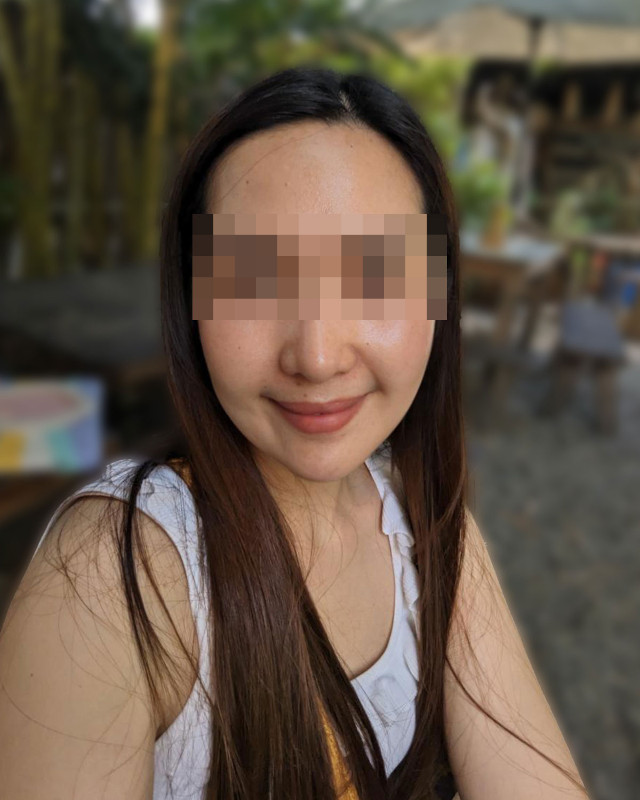
How To Protect Yourself From Experiencing Unsatisfactory Nose Job Results
So how can one avoid the entire traumatic experience that Liz had to go through? These tips from revision rhinoplasty specialist Dr. Richard Enrique, FPSO-HNS:
- Check for a pattern. While infection can happen to anybody, be wary if it seems to be happening all the time with certain doctors.
- Look for the results with previous patients. If your requirement meets the usual cosmetic outcome of your surgeon’s previous patients, a similar outcome will likely be attained for you.
- Let your doctor examine you personally. He should check the external and internal parts of your nose. If you have nasal septal deviation or a crooked nose, that should be corrected first. If you put something on a nose that is already crooked, it will become more pronounced.
- Beware of marketing strategies. Don’t be enticed by offers of free revision because, in the first place, a doctor should do your surgery without any intention of doing it again.
Feeling distressed after your nose job? Help is available. Contact the following:
National Mental Health Crisis Hotline: 0966 3514518, 0917 8998727 or 0908 6392672.
Visit the NCMH Facebook page. Alternatively, send an email to the Philippine Mental Health Association at cisd@pmha.org.ph to schedule an appointment.
If you need peer support from people who underwent rhinoplasty or just need someone to talk to, join The ORIGINAL RHINOPLASTY SUPPORT GROUP PHILIPPINES (OFFICIAL). There will always be someone who will be willing to help.
*Names have been changed.