
Trigger warning: discussions around miscarriage and the loss of a child
Martine Cajucom-Ho bravely disclosed a deeply personal story on her Instagram account.
On April 2, 2024, Martine engaged with her followers through an Instagram story question-and-answer session about the egg retrieval process. The influencer-turned-entrepreneur shared that she and husband Cliff Ho have been trying to conceive a second baby through in vitro fertilization (IVF).
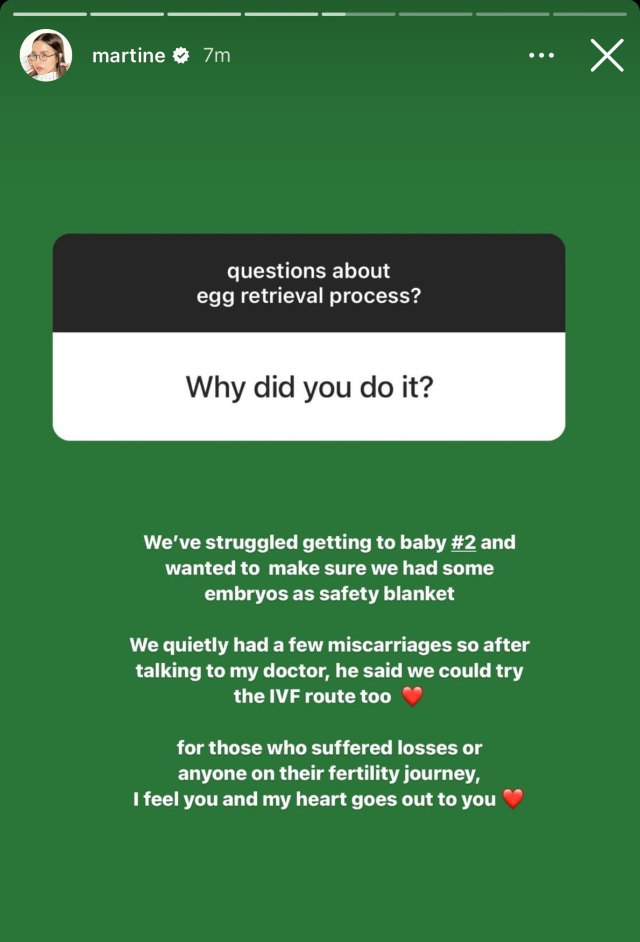
She revealed that they sought the help and services of a fertility clinic in Melbourne, Australia. "We've struggled getting to baby #2 and wanted to make sure we had some embryos as a safety blanket. [...] I did mine through create fertility in Melbourne which was a great experience," she wrote on Instagram.
Along with sharing advice, Martine admitted to experiencing miscarriages along the way. Hence, they were advised to try IVF. "We quietly had a few miscarriages so after talking to my doctor, he said we could try the IVF route too," Martine said.
Martine greatly empathized with all who are struggling on their pregnancy journey: "For those who suffered losses or anyone on their fertility journey, I feel you and my heart goes out to you."
Martine also spent some time discussing her experience—from the difficulties of starting the IVF process to its possible side effects.
A lot of the questions were concerned about how much bodily pain the process would cause. In the calmest manner, Martine responded saying, "I actually didn't think the injections were that painful and I am so scared of needles and have a low pain tolerance. (ice packs make a massive difference!) Side effects: bloating, bruising at the injection site, increased appetite."
Was the egg retrieval process painful? "No, I was asleep under general anesthesia and afterward, I was just tired and wanted to be a couch potato. Slight cramps but nothing significant or bothersome."
READ ALSO: Doug Kramer Opens Up About Failed IVF Attempts: 'It hurts...especially for Chesca'
Martine Ho explains her IVF experience
In case you're wondering about IVF, Monash IVF Australia (as linked by Martine) defines IVF as "a fertility treatment where an egg and sperm are combined outside the body in a laboratory, allowing the fertilised embryo to develop before being transferred to the uterus to increase the likelihood of pregnancy."
IVF is usually recommended for women who experience recurring miscarriages, blocked fallopian tubes, endometriosis, and other diseases that affect the chances of pregnancy.
What happens during the IVF egg retrieval process?
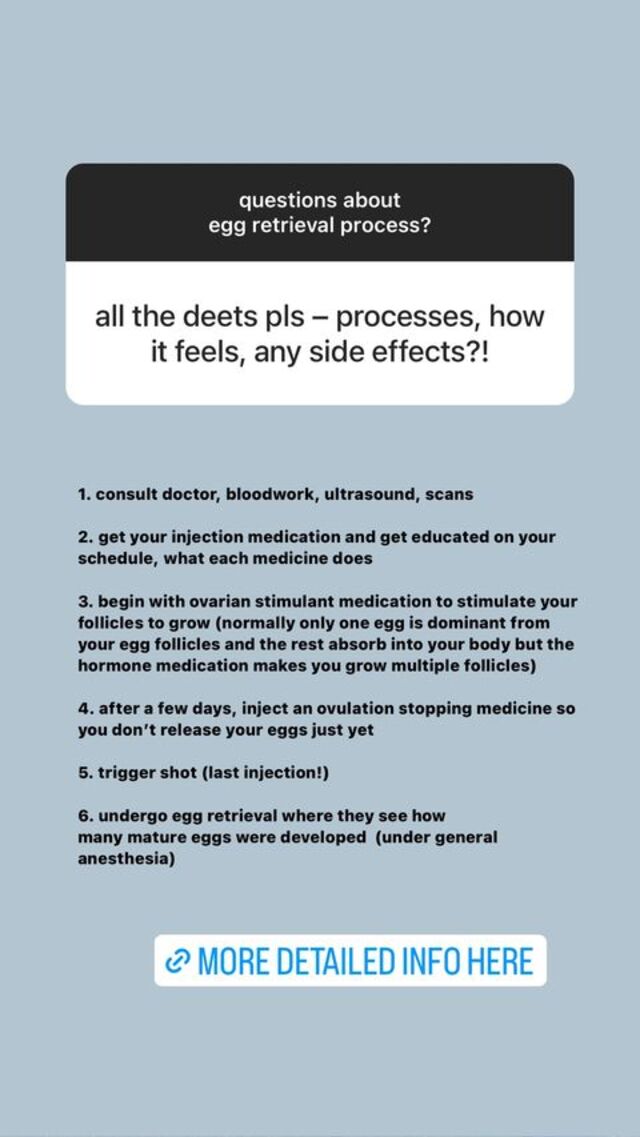
- Consult your doctor.
- Collect your injection medication. Read up on your schedule, plus what each medicine does. Martine highlighted how it's important to be educated on every medicine injected into your body and the processes the body undergoes.
- Begin using ovarian stimulant medication to stimulate your egg follicles to grow.
- Inject an ovulation stopping medicine after several days to prevent the premature release of your eggs.
- Use the trigger shot (your last injection for this round of the process).
- Undergo egg retrieval (under general anesthesia) so the doctor/s can see how many mature eggs were developed.
The IVF egg retrieval process also requires you to undergo bloodwork, ultrasounds, and medical scans, to monitor your condition throughout the entire process.
Martine Ho on freezing her eggs
ICYDK, Martine is married to TV Host Cliff Ho and they are parents to an adorable baby girl, Penelope Martine. The couple is not ruling out conceiving a baby the natural way. However, they're doing everything they can, including taking the IVF route.
"Still will try natural too. I'm not ruling it out but will keep our embryos for a rainy day or if natural doesn't work it," she remarked via an Instagram story.
READ MORE:
- All The Things You Probably Didn't Know About Freezing Your Eggs
- You Need To Read This: How To Freeze Your Eggs In Metro Manila
When is the best time to have your eggs frozen for in-vitro fertilization (IVF)?
When asked about the "prime time" to have your eggs frozen, Martine says to go for it at any given time, as long as you have the means to do it. But she also explained that someone between the age of 20 to 35 is the best candidate for freezing one's eggs.
"Your eggs in your 20s are the best quality and after 35, egg quality has a massive drop off. So if you're thinking of doing it, earlier is better and I highly encourage anyone, if they have the means to do so, to go for it 100%. With that said, I'd definitely still do it if I was in my later 30s," Martine clarified.
After all, Martine encourages everyone to not be scared of IVF and the processes that freezing eggs entails. She also sends out her support to everyone trying to build a family. "If I can survive this, literally anyone can because I'm scared of everything and think everything hurts [...] For those who suffered losses or anyone on their fertility journey, I feel you and my heart goes out to you," Martine wrote.
If you feel that you need help and advice for yourself or anyone else, please contact The National Center for Mental Health (NCMH) Crisis Hotline, a 24/7 confidential services hotline for psychiatric emergencies, suicidal thoughts, depression, and other issues at (02) 7989-8727 or (0917) 899-8727 (or 0917 899-USAP). Here is a more complete list of Philippine hotlines you can reach out to for further assistance.