“For most of history, anonymous was a history.” Virginia Woolf was right on the nose with that quote. And to make matters worse, men, more often than not, took full credit for inventions made by women. The reason? Because they could.
In some cases, it was a matter of superiors having a sense of misplaced ownership of the wisdom of their subordinates. In the worst cases, it was point-blank theft. Back in the day, society was so unaccustomed to the idea that women have brains that it was second nature for them to attribute major breakthroughs to dudes. Because, apparently, the feeble female mind was only good for childrearing and embroidery.
So in honor of the women who were forced to endure, here’s a list of women whose world-changing accomplishments were unfairly credited to men.
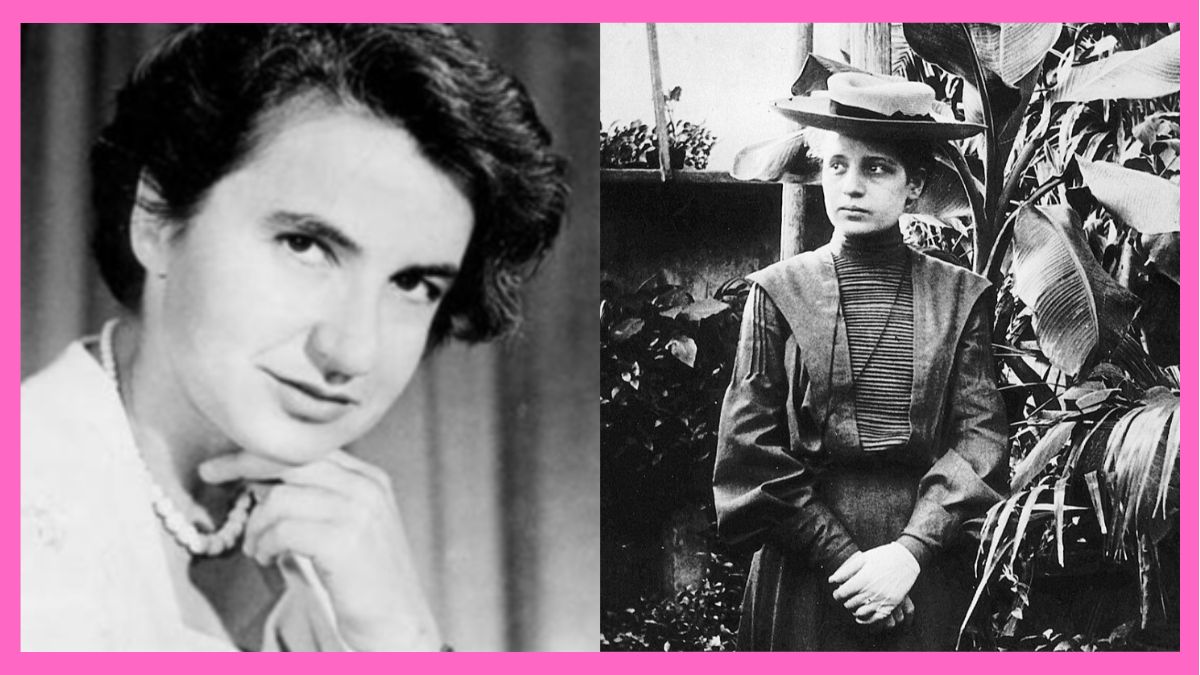
Rosalind Franklin | DNA
%20(1).jpg)
Lise Meitner | Nuclear Fission
.jpg)
Lise Meitner was an Austrian physicist whose work was, unintentionally, integral to the development of the first atomic bomb and, subsequently, other nuclear weapons. In 1938, a team led by chemist Otto Hahn found that uranium atoms could be split by bombarding it with neutrons. Shocked by this discovery, Hanh contacted Meitner, a former colleague. With the aid of fellow physicist Otto Frisch, she then ultimately described this theory. She even coined the name nuclear fission, aka the explosive potential of splitting heavy atomic nucleus like that of uranium or plutonium.
Yet in 1944, the Nobel Prize in Chemistry was awarded solely to Hanh, disregarding the contributions of Meitner and Frisch.
Nettie Stevens | Sex Chromosomes

Nettie Stevens was an American biologist and geneticist who discovered why babies are either born male or female. In 1905, using experiments with yellow mealworm beetles, she discovered that a specific configuration of chromosomes known as X and Y is responsible for pre-determining an individual’s sex.
However, credit for this discovery is often attributed to her colleague and mentor E.B. Wilson, who published a paper with similar results around the same time as Stevens. But even though it was Stevens who arrived at a stronger and more accurate conclusion, Wilson was the one who received credit because of his reputation and contribution to other areas.
Elizabeth Magie Phillips | Monopoly
.jpg)
Elizabeth Magie Phillips, also called Lizzie Magie, was an American game designer, writer, and feminist. In 1903, Phillips filed a patent for “The Landlord’s Game,” a board game that was born out of her strongly-held belief in Henry George’s system of land economics. Ironically, the game was also invented to protest known monopolist men like John Rockefeller and Andrew Carnegie.
Just as the game began circulating among niche communities, Charles Darrow received a patent for “Monopoly,” an “upgraded” version of Phillips’ invention. Monopoly was eventually sold to the Parkers Brothers, who only started manufacturing what was to become one of the most popular games in the world 30 decades after Phillips’ legal claim. After the success of Monopoly, Phillips's contribution was largely lost to history.
Margaret Knight | Paper Bag Machine

Margaret Knight was a prolific American inventor of machines for both industrial and everyday use. In 1868, while working at a paper bag factory, she came to the realization that packing a bag would be easier if it had a flat bottom. This prompted her to create an attachment for paper-bag-folding machines that allowed for the mass production of square-bottomed bags.
But as she set out to file a patent, she discovered that not only did a man named Charles Annon steal the idea, he took it upon himself to patent it as his own as well. When Knight took him to court, Annon’s argument was that “no woman could be capable of designing such a machine.” He was proven to be a money-grubbing fraud when Knight presented multiple meticulously drawn blueprints of the invention. She rightfully received her patent in 1871.
*This story originally appeared on Esquiremag.ph. Minor edits have been made by Cosmo.ph editors.