"Revenge travel" is indeed a thing, but with the surge in people wanting to get out of their homes post-lockdown, many travelers are finding it more difficult to deal with one point of concern: Airports. Lines are getting longer, some flights are getting delayed (or even canceled), and a handful of Immigration Officers are headlining the news due to their non-typical questions, like asking for a yearbook or 10 birth certificates.
To help you get through the airport as quickly as possible, we've put together a list of important don'ts to avoid the next time you, your friends, and/or your family arrive at the airport.
Here are 8 things NOT to do the next time you're at the airport:
1. Do not forget to account for long lines at the airport.
Being on time is crucial, so when you show up late you not only risk missing your flight, but you make the experience worse for your fellow passengers and the airline crew — who are kept waiting while they page you via final boarding calls. And with the amount of traffic these days, it's best to arrive at least 2-3 hours before your flight to ensure you have enough time to check in, go through security, and find your boarding gate.
2. Do not talk to strangers (or worse, accept items from them).
Although Filipinos are known for their hospitality, there should be a limit to our courtesy torwards strangers. If a random person approaches you to ask for help in dealing with overweight luggage, just say no. There have been countless cases where someone was taken advantage of by scammers, who asked them to carry a bag or add an item to their luggage.
They may offer to pay you, or they might trick you into thinking you're helping them or their family. But chances are that may be a prohibited item, such as drugs. Never carry a bag or package for anyone you've just met. And even if you're transporting something on a trusted friend or relative's behalf, it is perfectly alright to ask them what's inside. After all, it might be a restricted item in your next destination (yes, even perishable goods like fruits!).
It's good to be wary of scams that affect travelers. In fact, from 2015 to 2016 news sites constantly reported on the NAIA bullet-planting scandal, known locally as the tanim-bala or laglag-bala scam. Scammers targeted travelers (mostly OFWs, senior citizens, and tourists) by planting a bullet in their baggage. The victims then had to deal with fines, or even the possibility of being charged with illegal possession of ammunition. In July 2016, then-president Rodrigo Duterte put a halt to the tanim-bala scheme by prohibiting authorities from detaining or arresting passengers if ammunition is confiscated from them. So always be aware of your valuables and keep an eye out on your surroundings, especially if you're traveling.
3. Do not make a bomb joke.
Just don't do it. Not only will your "joke" be reported to appropriate personnel, you can and will be asked to disembark the airplane — along with the rest of your fellow passengers. The airline will then have to re-screen all checked-in baggage and carry-on items, further inconveniencing people by delaying the flight. Whether you make that joke while onboard a plane or at the airport counter, it's not only in poor taste but illegal.
You can be charged with violating the PD 1727, also known as the anti-bomb joke law. Convicted felons shall be punished with a fine of up to P40,000, imprisonment of not more than five years, or both at the discretion of the court.
4. Do not use terminology unfamiliar to Airport Security.
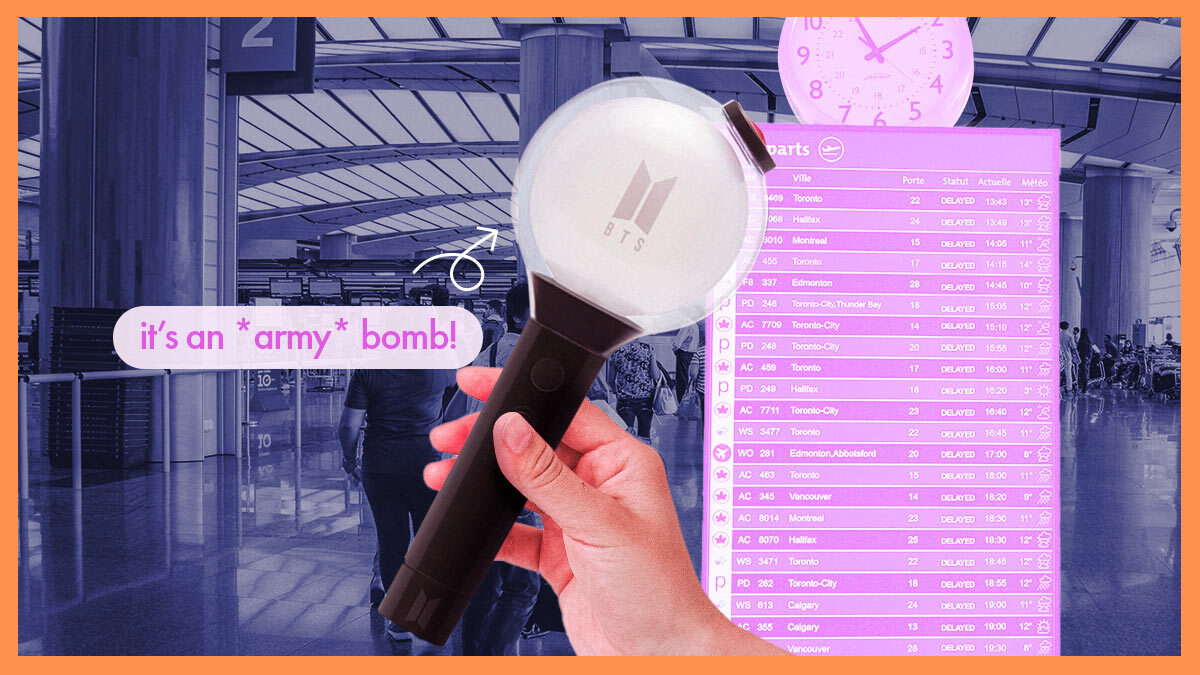
K-pop fans, this is for you: Although terms like "army bomb" (if you're a BTS fan) or "bong" ("stick" in Korean, aka the general word for a lightstick) are used frequently in the fandom, to the unfamiliar just hearing those words are possible red flags. So the next time an Airport Security officer asks you what's in your bag, tell them "it's a lightstick for concerts" — and make sure to keep your extra batteries in your carry-on baggage!
6. Do not be unprepared when it's your turn with an Immigration Officer.
Technically, all the Immigration Officer (IO) needs to allow you out of the country are the following documents:
- A valid ID
- A passport valid for at least 6 months from the date of your departure
- A return ticket
- A visa (if required)
- Overseas Employment Certificate (if necessary)
When answering questions, it's best to keep your responses short and to the point. Giving unnecessary details might lead to additional follow-up queries, something you'll be wanting to avoid if you're pressed for time. Here are the standard questions an IO might ask you:
- Where are you going?
- What will you do there?
- When will you return to the Philippines? May I see your return ticket?
- (If traveling alone) Why are you traveling alone?
- What is your occupation here in the Philippines?
- Immigration officers can ask for proof on how you can afford to travel. In this case, you can show your debit card or credit card, or your bank documents.
- Your place of residence at your destination country is important. IOs may ask you to present a hotel reservation, or your letter of invitation to stay.
- If you say you have relatives abroad, they may ask you to present your proof of a relationship.
- If it is a business trip, be ready to show proof as well. This can range between a company letter of invitation to an official itinerary.
Always have your documents ready — in fact, keep all necessary documents in an easily-accessible folder so they're all in one place and ready for you to collect if and when your IO asks for documentation. It's good to have an additional valid ID (such as your driver's license) onhand, to verify your personal details.
7. Do not allow an Immigration Officer to take your cellphone without consent.
In a case that went viral in March 2023, Filipina traveler Cham Tanteras posted a TikTok video describing her experience with an immigration officer that caused her to miss her flight. Aside from a lengthy interview, she was asked to present her yearbook and graduation photo.
Bureau of Immigration (BI) spokesperson Dana Sandoval said in a CNN Philippines interview that asking for a yearbook is not standard procedure. And since Cham Tanteras was not a minor, asking about the marital status of her parents was also "not normal."
Cham Tanteras also said that the IO "grabbed" her phone during the interview. Immigration officers are not allowed to get passengers' mobile phones or gadgets without their consent.
8. Do not forget to bring a pen.
Starting May 1, 2023, the Bureau of Immigration has stopped using paper-based Departure Cards and switched to the online eTravel portal, which all passengers are required to fill out no earlier than 72 hours to not later than three hours from the scheduled time of their flight.
Although travelers flying through NAIA are no longer required to fill in paperwork prior to departure, bring a pen just in case you need to note things down or fill in additional documentation.