The Sustainability Stewards are holding the line for Masungi.

NPC Seal of Registration
Cosmo.ph has been granted the NPC Seal of Registration in recognition of the successful registration of its DPO and DPS
The Sustainability Stewards are holding the line for Masungi.

Spanning 27,980 hectares, with 60-million-old limestones, three to four hours of trail time, and over over 400 flora and fauna, an hour and a half away from Metro Manila—there aren't enough figures to describe the magnitude of Masungi Georeserve's importance in the Philippines. Nestled in the southern part of Sierra Madre—the country's longest mountain range and force against climate change—the award-winning conservation area is an essential watershed and a biodiversity haven. But zooming into its massiveness further back in the 1990s, you would've spotted a young girl who wasn't exactly enthusiastic yet.
"As a child, on weekends, my dad [who had a project in that area] would bring us, and I remember being bored as a child," Billie Dumaliang quips, sharing her earliest memory of Masungi Georeserve. "There were no toys, there was no Internet."
Billie's love for the environment wasn't a slow burn—it was rooted in her youth, growing alongside her sister Ann Dumaliang, long before they co-founded Masungi Georeserve.
"We both came from Miriam College, so 'yung uniform pa lang namin, very green. Our campus was also very clean, and there was a huge pillar of environmental integrity in the work that we do," Billie says, and Ann continues, "Social justice. Parang 'peace, and integrity of God's creation' was put on our blackboard. So that's for everyone to memorize through kindergarten up until high school."
Billie, also the Advocacy Director of Masungi, stresses that she was a science geek, and it helped that they had grandparents who were in the world of academe. "We grew up in a knowledge-driven household. We had copies of National Geographic, all the magazines and all the encyclopedias. At an early age, we had a very keen interest in science and the exploration of the natural world."
Meanwhile, Ann reveals that she found herself having a close relationship with Masungi's landscape at an early age. This love later evolved to the need to fight for it.
In Ann's POV, the eureka moment played out like this: "Hearing my dad on the phone talk about how our rangers were being brought to prison for taking care of the landscape. When I was in high school, I think that would have been my first awareness of injustice that people were encountering on the field," she recounts. "That's what made me want to be able to help the people who are protecting the place, and to play a closer role in managing it and allowing it to be successful."
Ann, also a Managing Trustee of Masungi, remembers "standing on top of one of the mountains, with the view of Manila, and then just realizing that all of the mountains there before weren't there anymore. So it was very clear that the time to protect it was already now. Because it would be the next landscape to experience threats, if you look at it from an urban sprawl perspective."
Billie recalls, "It was also a journey of seeing the landscape transform into something that's loved by myself and a lot of other people, because dati that it was barren, it was desolate, it was alone, 'di ba?" She adds, "And now, it's great to see that people from all over the world go to it and love it and appreciate it because of the hard work and dedication that the team has put into it for the last couple of decades.”
These efforts are not without massive challenges—restoring 2,700 hectares of land often feels like an uphill battle. In a country deemed one of the most dangerous in Asia for environmental defenders, the Masungi conservationists—named among TIME's Next Generation Leaders 2024—have faced threats ranging from land-grabbing and illegal logging to disinformation and violence. In 2021, their rangers filed frustrated murder complaints after a shooting incident linked to a disputed development project near the protected area. More recently, a proposed wind farm by a Singapore-based company has raised concerns about its impact on the sanctuary’s vulnerable ecosystems.
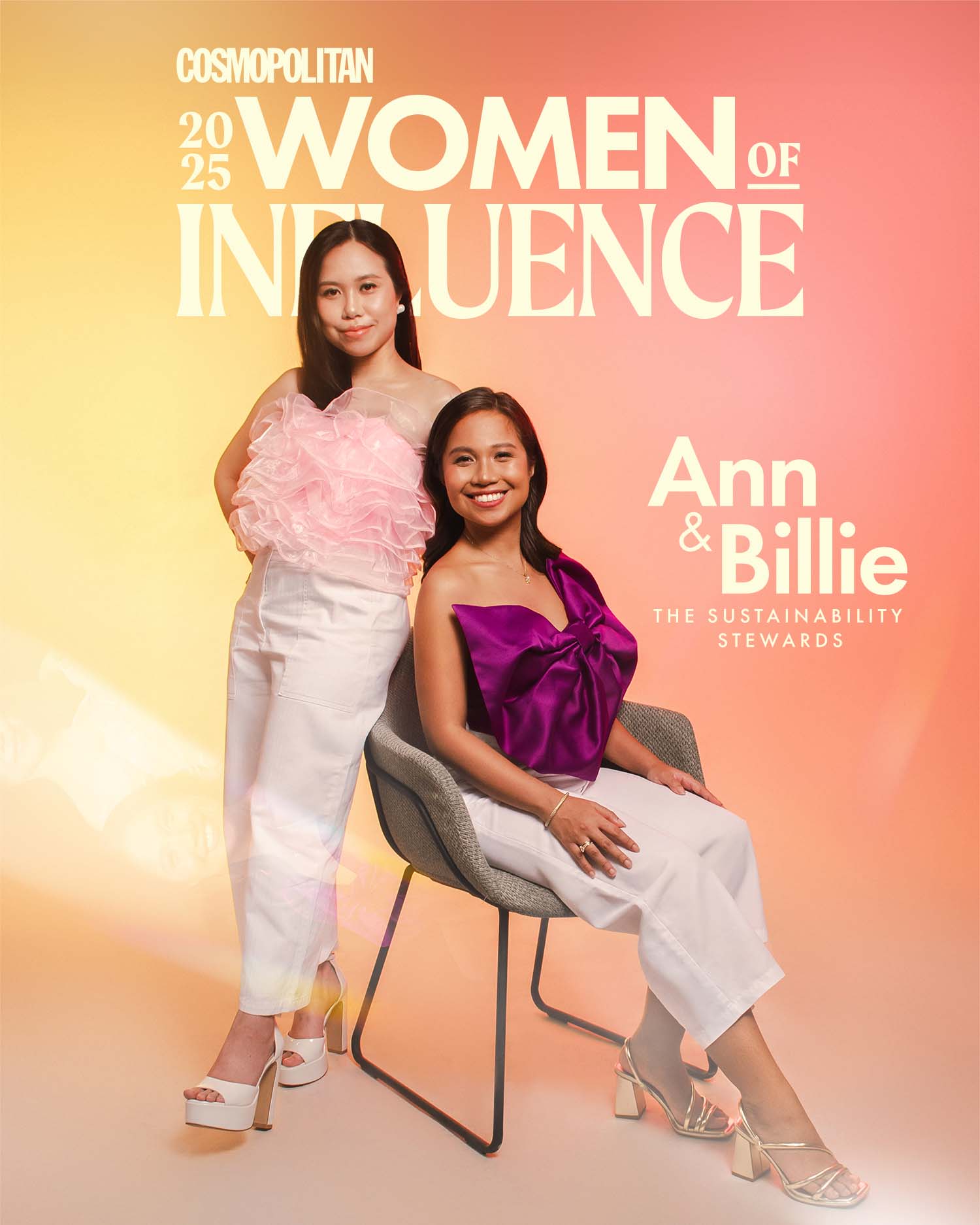
Ann and Billie Dumaliang For Cosmopolitan Philippines Women Of Influence 2025
Photographed by Miggy Broño
As Women of Influence awardees and our distinguised Sustainability Stewards, Ann and Billie Dumaliang aren't just protecting landscapes—they're redefining the conversation on conservation. We talk to the millennial conservationist sisters-slash-collaborators about navigating sexism in their field, their love for science, the essence of strength, and the urgency of representation.
[Editor's note: This interview has been edited and condensed for clarity.]
Ann: It gave me the space to get to know the landscape at a deeper level. We knew it personally, but I didn't have the opportunity to understand the diversity of life in it—the different kinds of landscape and what made them stand out and what made them special until my National Geographic project. It was particularly about creating identity of place and the greener culture for the area. That's where my belief that understanding the place you operate in will inevitably make you want to take care of it and make you understand what it means to take care of it [comes from].
Billie: It's an honor to be part of the cohort which has a tenure of two years, from 2024 to 2026. It's great to really have access to these high-level meetings and high-level conferences and leaders so that we can directly push the youth and environment agenda [on] such an international stage.
Because of the program, I've been able to participate at the recent 2024 UN land conference in Riyadh, Saudi Arabia. It was great to connect to world media, world leaders, and fellow youth champions to know what's happening all over the world, and hopefully bring back all those lessons and insights from the international stage to the Philippines.

Billie: I'm not just a woman. I am a young person. I'm also a petite person. I'm also from the Global South. So there's lots of biases and misconceptions and parang ang napapansin ko na na-u-underestimate kapag nakitang maliit or babae ka. But if you can show them that you can speak and you can act and take action as much as any human being can, or as much as men can, they will grow to learn to respect you and your position as a person.
For example, you have meetings and you're talking about important things like watershed conservation and stopping illegal activities. Sometimes, hindi ka sine-seryoso lalo na kapag kausap mo mga "macho" people. So that's pretty hard, but that's the reality we have to face. We have to talk to different people, and we have to show them that we're serious about what we're saying and that actions speak louder than words, we just try to continue to do what we do to deserve their respect and attention. If they don't want to listen to us, we make them listen to us.
Ann: People do not like strong women of that sort.
Billie: Oh, yeah. [Gen Zs] know the use of a platform more than us. For example, TikTok. It has also become a medium for social awareness, for raising these issues in a kind of digestible [and] fun way, so nag-a-ask kami kapag may Gen Z kaming nakikita: "How can we get to speak to you better? How can you help us bring out this message to the next generation?" The creativity and boldness of Gen Z [are what we] get inspiration from.
Ann: What I love about [young people], since Billie already talked about how a lot of young people are more hiyang with technology, is the social aspect of it as well. It's a lot easier for young people to come together towards a common cause, and especially in the climate space, it feels less like there's competition, and more like we are here to support each other and fill in the gaps. That sense of community is there, and that appreciation for diversity—may it be in gender or capability or inclinations—is also there. And I think as a community of young people, we're all the better for it.

Billie: We imagine that we protect these remaining green spaces as well as create more green spaces. Masungi is heavily threatened because of this proximity to Manila. It's just over an hour from Metro Manila, so you can imagine the pressure of urbanization, development, aggression, going into our area.
Yesterday, I was looking into our reforestation site, and it's like a triangular range of mountains or cluster of mountains. If you look at the left side of the mountain, that's our reforestation project, and it's green, it's glowing already. But if you look at the right side [of the mountain], there's ongoing [land] development there. So on one hand, nakakalungkot, 'pag tiningnan mo 'yun, binubuwag na nila 'yung bundok, wala yung green diyan, kitang kita ’yung scars sa bundok to make those wide roads, road network for a wind farm there.
Then on the other side, makikita mo 'yung green. So sad siya kasi nangyayari pa rin ’to and so close to these biodiversity hotspots and protected areas. Pinapayagan pa rin siya, nangyayari pa rin. [Pero maiisip] mo rin, "Oh my god, if we didn't pursue this project, if wala tayo diyan, they would have gotten the whole triangle cluster of mountains; [they] would have been brown by then, hindi lang 'yung right side. They would have certainly destroyed the forest by now. So it also makes me happy na, "Okay, what we're doing is actually making a huge difference, because we're not just talking about feet or meters. We're talking about whole mountains that we're saving, whole landscapes."
To [answer] your question, we can do it. It is possible if we take bold, courageous steps to protect these spaces. If we come together as communities, as Filipinos, kaya pala.
Billie: Siyempre, because family members are your closest ties, you have this level of trust with them that's a given, right? So you don't need to kind of have any doubt about this person's loyalty, or this person's intentions, because [they’re] your family and, you know you have these similar values.
Ann: It makes it so much easier, ’di ba?
Billie: Yeah, if we work together, it makes things faster because there's less back and forth, the values are generally aligned. Mas madali to innovate. Siyempre may downsides, pero those are normal naman.
Billie: Yeah, this is an active thing. It has to be active because representation in leadership or representation in these programs, even sa international sphere projects that we have with development partners, it always has to have a gender-based analysis, ’di ba?
We think about how program components can affect different genders differently, and how do we address that? How do we ensure different genders, not just women and men, but LGBT+, how can they take a meaningful part in this program or this project?
So maganda ’yun during this analysis, we can design programs, design projects, we'll take into account the differences between all these different genders. So that is a really active exercise, because you have to think, you have to map out these things. You have to consult people. Definitely, it's an active thing to make sure there is gender representation or equality in what we do.
Ann: Yeah, on the field naman there's still biases against women talaga when it comes to what they can do, and some of them make sense, like biology, right? But it's also about leaning into the strengths of different genders for different kinds of activities. Then, there's also a need to lend your power or lend your weight to women who otherwise would not even be heard or given a chance.
Billie: She's powerful. She can create, she can revive herself. She can regenerate.
Ann: You literally can't exist without her.

Billie: I guess playful, because I like challenges. I like competition. But also I like to have fun.
Ann: Elements na lang ako. I would count myself as fire, or like, a flame.
Ann: I'm a water sign, but when I pick my Pokemon, there's no doubt that I would pick a fire Pokemon.
Billie: Girlhood is that bond between women where you can talk to each other about anything. You can share common experiences. You can share 'yung rants niyo. Whether it's good or bad experiences, you can share it with them. And all those shared experiences between women, the camaraderie, the company that you give each other—that's irreplaceable. We experienced this because we're four sisters; we have two younger sisters.
Ann: Although it's not just limited to one stage, it's that constant self-discovery also of finding out your own self and identity and being comfortable with that, and how it evolves through time.
Billie: Safety from harassment, safety from preconceptions. When you're out in the field, it's hard to be a woman kasi madilim, walang kasama, and you’re vulnerable to physical or sexual exploitation, or abuse. I hope now women can be provided more security and safety.
Ann: For me, it's really seeing more women leaders in the communities that we operate in. Normally that's still traditionally held by men. And also—less about gender now—but on the field, I also want to see people embrace feminine traits as a form of strength. It's people's obsession with toxic masculinity and traditional measures of success that causes a lot of conflict in the field, actually.
But if you extend a bit more understanding, empathy and the listening ear, and an understanding that you need to care for people's health and well-being—which is not restricted to women, it's something that could also be practiced by men—then it would be less of a divisive experience for the field. It would be a healthier place for everyone. We can focus on the things that we should all be pushing for.
Billie: [Ask them] how they're doing, "Is there some way I can help you?" Personally, I have PMDD (premenstrual dysphoric disorder) which [only women get]. So we have these hormonal concerns as well. So 'di ba parang guys, like 30 days in a month, are probably fine or [in] the same level. But women, because we have this hormonal cycle, the period, there's a time na nag-iiba 'yung moods natin, so it's difficult. It's already difficult for women to operate because of these body changes. It's important to extend compassion doon sa nararamdaman ng mga babae physically, mentally, spiritually.
***
PHOTOGRAPHER: Miggy Broño
ART DIRECTOR: Ica Del Mundo, assisted by Bea Bognot and Bea Malonzo
ASSOCIATE EDITOR: Ida Aldana
PRODUCER: Alyana Olivar
MAKEUP: Jazthine Manaloto
HAIR: Nikko Bruel
STORY: Jelou Galang
VIDEO: Cherrie Julian, Jino Del Mundo, and Greeko Junio
SOCIAL MEDIA: Aina Lizarondo, assisted by Elsa Macanilao