For some, a person's sexual history—or what the Internet often calls "body count"—still factors into dating preferences. It's an age-old debate that has resurfaced on social media, drawing a range of opinions and heated discussions.
The latest round of hot takes started on TikTok, where users began proudly sharing that one of their "biggest flexes" is not having gone through a so-called "hoe phase." Some framed it as a matter of pride or discipline, while others implied that such a phase might make someone less desirable for long-term commitment.
While there's no universal definition, a "hoe phase" is typically described as a period when someone explores their sexuality, engages in casual dating or relationships, and prioritizes self-discovery over traditional romantic norms. In simpler terms: it's a time of figuring things out, without necessarily aiming for commitment.
As more users chimed in across platforms like Reddit and TikTok, one thing became clear: the conversation isn't really about the "hoe phase" itself—it's about how society still polices sexual behavior, especially when it comes to women.

So... does a "hoe phase" really matter according to Reddit?
According to many Reddit users, the idea that someone's worth in a relationship should be tied to their sexual past is outdated at best—and rooted in double standards at worst.
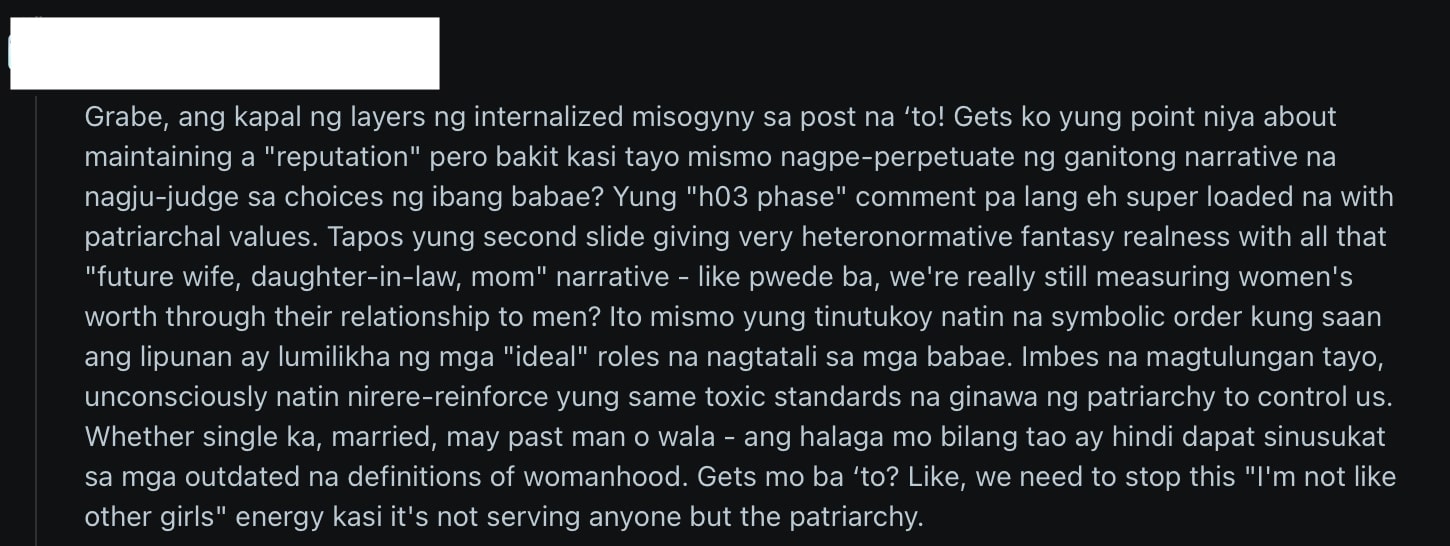
"Grabe, ang kapal ng layers ng internalized misogyny sa post na 'to! Gets ko yung point niya about maintaining a 'reputation' pero bakit kasi tayo mismo nagpe-perpetuate ng ganitong narrative na nagju-judge sa choices ng ibang babae?" a Reddit user questioned.
"Yung 'h03 phase' comment pa lang eh super loaded na with patriarchal values. Tapos yung second slide giving very heteronormative fantasy realness with all that 'future wife, daughter-in-law, mom' narrative—like pwede ba, we're really still measuring women's worth through their relationship to men?" the same user added.
Another user highlighted the double standards often present in this narrative, saying, "Tanggapin ang katotohanan na magkakaiba ang opinyon ng lipunan pagdating sa lalaking babaero at babaeng babaero. Pag lalaki ang nambabae, 'ahh okay lang yan, makakahanap din yan ng babaeng magpapatino sa kanya.' Pag babae ang nag-e-enjoy at gusto lang makatikim ng ibang putahe, 'pokpok' na agad ang label ng lipunan."

One thing the discussion makes undeniably clear: the concept of a "hoe phase" is often used to police women's sexuality while giving men a pass for similar behavior. This double standard reflects deeper societal norms that unfairly tie a woman's value to her sexual history, perceived "purity," or relationship choices.
While people will always have different perspectives, what's non-negotiable is this: a person's worth is not defined by their sexual past. It shouldn’t be treated like a moral scoreboard—or used to rank people based on outdated expectations.
It Boils Down to Personal Preference
At the end of the day, whether or not someone goes through a hoe phase is a personal choice. Some say it's shaped by upbringing, others view it as a reflection of individual values and life experiences.
As one Reddit user put it, "Ok lang naman ito, kung ano preference natin eh di go, pero ito yung mga bagay na dapat hindi mo na sinasabi kasi wala naman magandang outcome sa sanlibutan. Wala medal sa totoong buhay, at the end of the day mas ok pa rin maging mabait kesa maayos ka nga, nakaka offend ka naman sa iba."

"Depende nalang talaga siguro sa tao if tatanggapin nya if yung partner nya [na] may hoe phase before," another user shared, echoing the sentiment that acceptance of someone's past is ultimately a personal decision—and it's up to each individual to define what they're comfortable with in a relationship.
However, it becomes problematic when personal preferences turn into judgments or animosity toward others who choose differently. Just because someone holds a particular view doesn't mean everyone else should think or live the same way. At its core, this conversation is—and should always be—about choice, free from imposed standards or judgment.
As one Reddit user wisely put it, "Sabi ko gawin mo kung ano ang nagpapasaya sa'yo basta healthy at safe at walang tinatapakan na tao. Ang hindi pag-ikot-ikot ay hindi naman talaga isang pagyayabang gaya ng pag-ikot-ikot din ay hindi isang pagyayabang.
A "Hoe Phase" Is A Personal Choice
Just like growing up and evolving as individuals, people go through different phases to figure out who they are and what they truly want. For some, the "hoe phase" is simply part of that journey—a period of self-exploration, reflection, and learning about boundaries and desires. It's one of many experiences that help shape the person they become.
As another Reddit user said, "Choice nyo magkaroon ng hoe phase kasi choice nyo yan pero wag kayong magalit sa mga taong di matanggap yung isang tao na nagka-hoe phase kasi choice din nya yun."

"Body count doesn't define a person. Pag ayaw mo sa ganun, move over. Sundin nyo lang preference nyo then go on with your life," another user added.

For others, the hoe phase is not just about exploration but also about reflection and growth. "At the end of the day, that choice reflected on what we are right now and that is important because bibigyan ka rin ng choice kung sino yung gusto mong makasama pag mag sesettle ka na," one user explained.
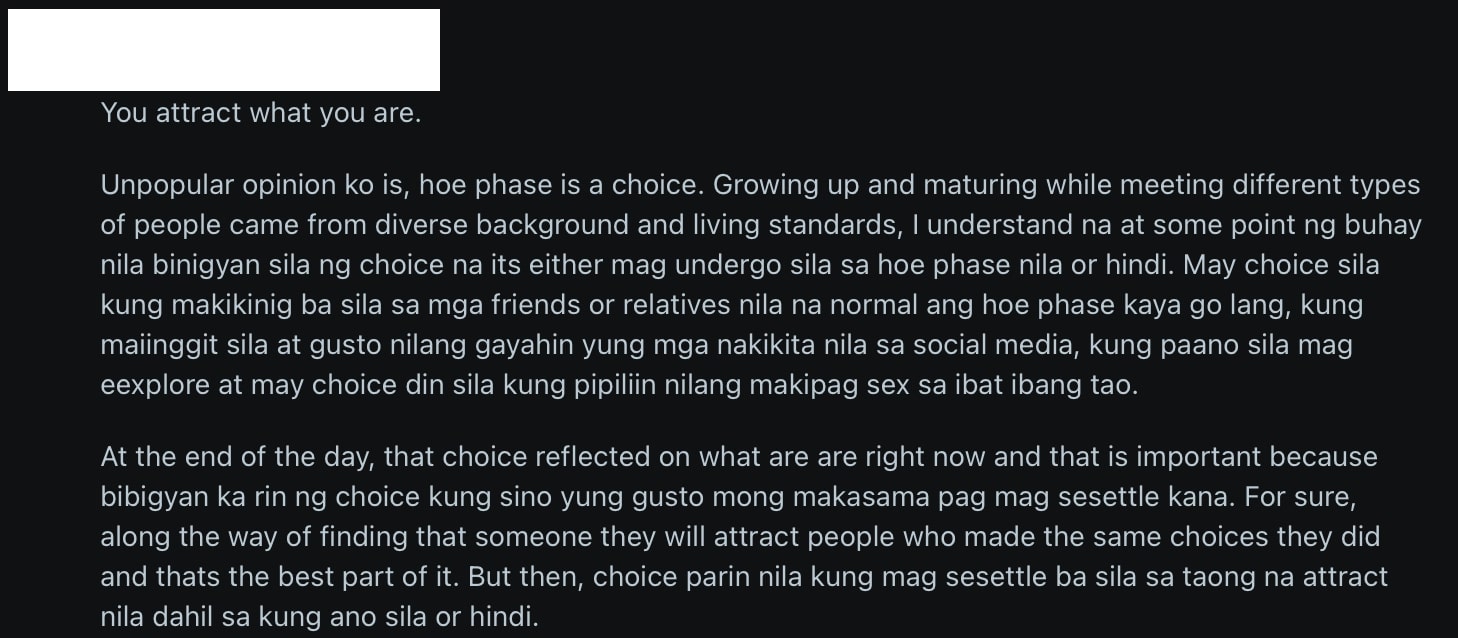
"For sure, along the way of finding that someone, they will attract people who made the same choices they did and that's the best part of it. But then, choice parin nila kung mag sesettle ba sila sa taong na attract nila dahil sa kung ano sila or hindi," the user added.