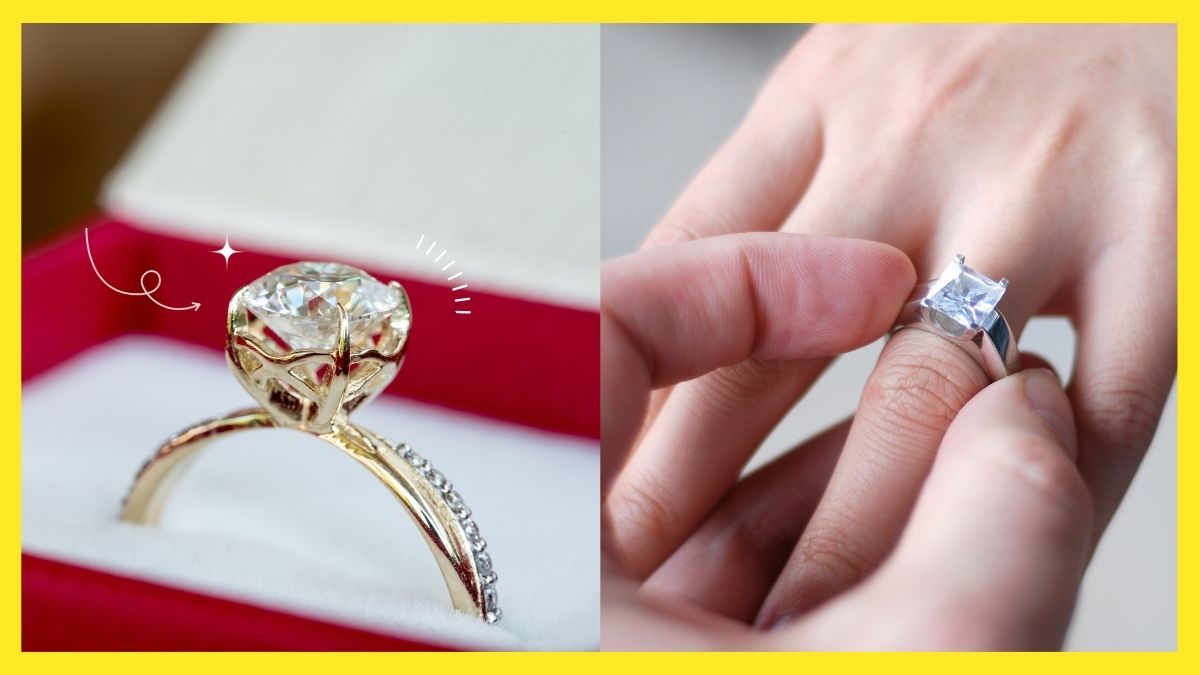
Shopping for a real diamond, or diamond jewelry of any kind can be an overwhelming experience, especially if you don't really know what you're doing. And let's be honest—who does?
You're making a huge investment in a piece you'll probably wear, at least semi-regularly, for the rest of your life. So, rather than sweat the small stuff, let us help with our expert-led guide to buying a diamond.
First things first: it's important to decide which four main 'Cs' you'd like your diamond to be. That's what carat, cut, color, and clarity. Not sure you know? Read our guides to the most popular engagement ring shapes and a variety of engagement ring colors here.
Aside from aesthetics, there's one other major factor you may not have thought to look out for.
We certainly didn't. That's why we enlisted the help of Grant Mobley, gemologist and director at Pluczenik, and Madie White, the founder of diamond jewelry brand Leo + Lumi, to learn all about lab-grown diamonds and how they differ from the real deal.
What's the difference between a lab-grown and a real diamond?
It's quite simple, according to Grant. "A real diamond is unique and rare, formed one hundred miles below the Earth’s surface up to three billion years ago," he explains. As a result, real diamonds undergo extraordinary environmental circumstances, bursting towards the earth’s surface through volcanic eruptions. "They are miracles of nature," he adds.
Lab-grown diamonds, on the other hand, are, as you may have guessed from the name, grown in a laboratory. "A lab-grown diamond is a stone that mimics the optical and chemical properties of a natural diamond". They are not formed through natural occurrences, rather they are artificially produced in a factory.
Are lab-grown and real diamonds worth the same?
Grant says that the difference in how these diamonds are formed means that only real diamonds have any "inherent value."
He says this is for two reasons. "First, there is not a sufficient history of lab-grown diamonds to determine what consumers are willing to consistently pay for them," he says.
"The second reason," Grant says, "is that I believe lab-grown diamond production will continue to get cheaper and cheaper as competition from factories in China grows, forcing producers to keep lowering their sales price for these stones."
Grant believes that if the value in lab-grown diamonds decreases dramatically, jewelry stores won't buy them back from the buyer, so you won't have the option to sell them on. This is the opposite of real diamonds, which increase in value over time due to their natural scarcity.
However, Madie disagrees with this, saying that lab-made diamonds can be as valuable as real diamonds but in different ways.
For example, the diamonds they use at Leo + Lumi are HPHT diamonds, "which stands for high pressure and high temperature," she elaborates. "Carbon seeds are used from pre-existing natural diamonds and put into a machine that re-creates the same environment in which a natural diamond is formed."
Then, once the lab diamond is created, it goes through the same grading system and certification process as natural diamonds. "This is why you'll still see on product listings we include clarity and color ratings," she explains.
How do you know which diamond you're buying?
According to Madie, the only difference between a lab-grown diamond and a natural diamond are their point of origin. "Lab diamonds are chemically, physically, and visually the exact same as diamonds that are mined from the Earth," she explains. "Even experienced diamond dealers aren't able to tell the difference, which is why most lab diamonds are stamped somewhere at the base." Without that, they'd be impossible to distinguish, she adds.
Grant agrees, confirming that it is almost impossible for the naked eye to tell the difference between a real and a lab-grown diamond. Want to know for sure? "Your jeweler should disclose what kind of stone you are looking at when you're shopping. If in doubt, ask to see the certification," he shares.
So, why would you buy lab-grown diamonds?
Because, sadly, natural diamonds are having a vast impact on the environment.
"Natural diamond mining has caused, among other brutal humanitarian issues, environmental devastation," Madie explains. How so? Well, irresponsible mining causes severe damage to the land. "This leads to things like soil erosion, deforestation, and relocation of local communities, due to lack of natural resources," she continues.
Although civil wars due to natural diamond mining have ended, she explains that the diamond industry is rife with unfair practices such as child labor, human rights violations, dangerous working conditions, and forced labor. "We work with a diamond supplier who shows how safe and ethical the creation of our diamonds are, so we know they come from a good place. Proving you have a safe lab is much easier than proving you have a safe, ethically staffed diamond mine," she concludes.
Should I buy a lab-grown or real diamond?
In short, it's totally up to you. There are pros and cons of each type, and each to their own, especially with a decision this big. It could be argued that real diamonds are more valuable than lab-grown diamonds, but on the environmental front, lab-grown diamonds seem to come up trumps.
Is it really worth investing in a real diamond if it causes environmental devastation along the way? On the other hand, is a diamond investment worth the price tag if you can't sell it later in life? That's for you to decide.
For all the reasons above, Grant says that the only type of diamond you should consider is a naturally-made "real" stone.
"We buy and wear diamonds because of what they represent", he says. "The word ‘diamond’ itself comes from a Greek origin meaning ‘unbreakable.’ It is because of a diamond’s rarity, strength, and resilience that they have come to be the ultimate representation of love, commitment, and success. The ability to keep diamonds forever and pass them down from generation to generation is a truly unique gift."
Whereas Madie believes there's no reason to buy real diamonds anymore. Case in point: What's the point of having one of the oldest stones on Earth on your finger if there's no longer an Earth to wear it on?
"Lab diamonds are a much more cost-friendly option. There's a shorter supply chain between the creation of the diamond and the final customer, which reduces the price by around 20 to 30 percent. This allows our customers to enjoy a conflict-free diamond which is physically, chemically, and visually the exact same as a natural diamond—-for a fraction of the price," she concludes.
***
This article originally appeared on Cosmopolitan.com/uk. Minor edits have been made by the Cosmo.ph editors.